


International Erasmus+ seminar: the cultural and creative industries sector: impact on the economy
On 3 December, Kaunas First Music School hosted an international event dedicated to the theme of cultural and creative industries. The day began with a concert by students from the ERASMUS+ project “Social Vibes & Biz: music, technologies and social entrepreneurship”, performed by the project partner – Ikšķile Music and Art School (Latvia) – in the Giedrius Kuprevičius Concert Hall. The young Latvian performers presented a colourful musical programme that captured the essence of the project – the value of music, creativity and international cooperation. Following the concert, the international seminar “International seminar on the creative industries sector and its impact on the economy / Kultūrinių ir kūrybinių industrijų sektorius: poveikis ekonomikai” took place, attended by representatives of all three institutions implementing the project: Spodris Kačans, Director of Ikšķile Music and Art School, Jurgita Bražinskienė, Director of the Association for Social Leadership, and Mindaugas Labanauskas, Principal of Kaunas First Music School.

The aim of the seminar was to provide teachers and cultural sector professionals with deeper knowledge about the structure of the cultural and creative industries (CCI) sector, its economic and social significance, opportunities for internationalisation and practical pathways for cooperation. The objectives included familiarising participants with the economic value generated by CCI, the sector’s impact on employment, innovation and social development, as well as current growth trends, challenges and the broader international context.
In the first part of the seminar, Jurgita Bražinskienė, Director of the Association for Social Leadership, presented the cultural and creative industries sector in Latvia.
Then she systematically compare it with the situation in Lithuania and the wider European context. She emphasised that cultural and creative industries form an intermediary link between culture and the economy – they encompass activities whose products and services are cultural, artistic or creative in nature and based on intellectual property, while the sector itself constantly balances between artistic and commercial logics. Drawing on the cultural and creative industries structure used by the Lithuanian Ministry of Culture, J. Bražinskienė reviewed a wide range of fields: from crafts, design, architecture, film, music, performing arts and publishing to the games industry, cultural education and various creative services. She noted that this is one of the fastest-growing branches of the economy, in which not only large but also small and micro-enterprises play an important role, particularly in terms of regional development.
When presenting the economic value created by CCI, the speaker discussed recent data showing that these industries represent a significant share of the Lithuanian economy: CCI enterprises account for several per cent of all business entities, tens of thousands of people work in the sector, and the added value it creates is comparable to – or even greater than – that of such traditional sectors as agriculture, real estate operations or the food industry. To illustrate how creativity is transformed into tangible economic results, J. Bražinskienė presented striking Lithuanian examples: the internationally recognised design object HR Bank (Tukas EV, designer Lukas Avėnas), virtual reality projects based on the work of M. K. Čiurlionis (“Angelų takais”, “Pasaulių sutvėrimas”), the success of the film sector, vividly demonstrated by the record-breaking box-office hit “Pietinia kronikas”, internationally visible achievements of Lithuanian music creators and performers, the opera-performance “Saulė ir jūra”, which became a global phenomenon, the Olympic medal in breaking won by B-girl Nicka (Dominika Banevič), and the rapidly growing games industry represented by globally known titles such as “Cooking Fever” and “Human Fall Flat”.
The speaker also provided an extensive overview of cultural and creative industries funding models in different countries. She presented examples from Finland, the Netherlands, the United Kingdom, France and Canada, highlighting long-term public funding, the role of “arm’s length” cultural councils, the use of lottery funds, tax incentives and measures to promote innovation and export. Attention was also drawn to the involvement of individuals – philanthropy, membership schemes, crowdfunding and good practices such as “Museokortti” and “Voordekunst”. Turning specifically to Latvia, J. Bražinskienė described the country’s CCI sector as a vibrant part of the economy where strong cultural traditions intersect with contemporary innovation.
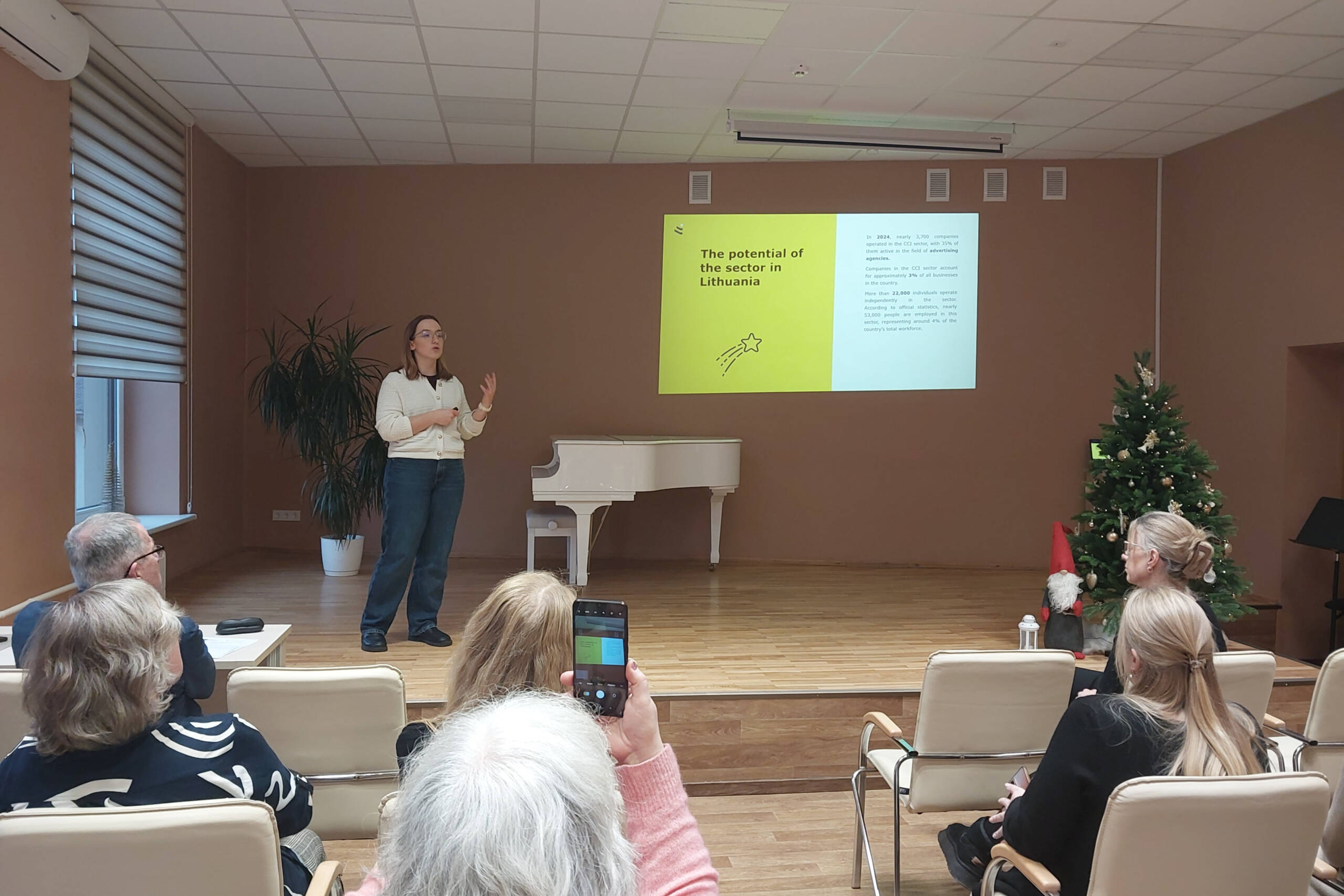

The ArtTech Hub currently being developed is, in V. M. Bružaitė’s words, a space where art, technology and business meet. It will host testing (“sandbox”) programmes for innovative solutions, pre-commercial procurement initiatives and targeted events designed to connect creators with participants from the “GovTech”, “GreenTech”, “BioTech”, space and other innovation ecosystems. The speaker presented the latest figures on Lithuania’s CCI sector: in 2024, it comprised almost 3,700 enterprises, about 35 per cent of which were advertising agencies; overall, CCI account for around 3 per cent of all business entities in Lithuania. The sector employs approximately 53,000 people, with a further 22,000-plus creators working as self-employed professionals.
Meaning that, taken together, this field represents around 4 per cent of the national labour market. Cultural and creative industries contribute about 3 per cent of GDP – comparable to the share of the food and beverages industry and, in some cases, exceeding that of certain high-tech sectors. Particularly prominent is the game development industry, which already generates around 300 million euros in annual revenue and aims to exceed the one-billion-euro threshold by 2030; in 2024, CCI exports reached 596 million euros, with Lithuanian creative products and services sold in more than 100 export markets.
V. M. Bružaitė went on to review the broad spectrum of CCI subsectors in Lithuania: design and crafts, publishing, advertising, audiovisual creation and IT (video games, digital and virtual content), architecture, museums and galleries, cultural tourism, music and the performing arts. According to the speaker, this diversity is precisely what enables the sector to remain dynamic and open to innovation. She then presented the strategic directions of the ArtTech Hub: individual consultations for creators and companies, access to information on funding instruments, specialised (pre-)acceleration programmes, and opportunities for national and international networking – from participation in international events to targeted “matchmaking” sessions with business and academic partners.
Particular attention was given to the CCI accelerator programme financed by EU funds until 2027. The pre-acceleration stage focuses on refining business models and value propositions, financial planning, strengthening sales, advancing digitalisation and assessing social impact. The “ArtTech” accelerator is oriented towards the digitalisation of creative products, the development of innovative services, the commercialisation of creativity and the protection of intellectual property. Other accelerators – in e-commerce, export and the circular economy – help creators strengthen online marketing, optimise e-shop performance, plan export strategies, analyse target markets and implement sustainability principles.
In concluding her presentation, Vaiva Marija Bružaitė underlined why Lithuania is an attractive country for international partners in the creative industries: it has a very high level of digitalisation, strong design, games and audiovisual content sectors, and fast-growing creative fields closely linked to technology. Future growth prospects are associated with further deepening of digitalisation, the expansion of CCI service exports, the attraction of audiovisual production, the clustering of creative activities in major cities and the strengthening of the talent ecosystem.
The international ERASMUS+ seminar at Kaunas First Music School became an important platform for dialogue between the education, culture and business sectors. The event strengthened cooperation among the partners of the “Social Vibes & Biz: music, technologies and social entrepreneurship” project and encouraged continued efforts to find new ways of integrating creativity, technologies and social entrepreneurship into contemporary educational practice.
Prepared by Dr. Domantas Milius, expert piano teacher.


ERASMUS+ KA210-SCH project „Social Vibes & Biz: music, technologies and social entrepreneurship“.
WP2 Teachers’ training.
A2.1.1 International seminar on the creative industries sector and its impact on the economy.


